It's the third week of October. Someone in your office is coughing. Your kid brought something home from school. Your throat has that unmistakable scratchy feeling, and you're doing the mental math: can I afford to get sick right now?
Here's the thing nobody tells you: October isn't random. In Chinese medicine, this month is practically circled on the calendar — it's the single hardest month of the year for your immune defenses. Not because of one virus, but because of what's happening to your terrain. Once you see it, you'll never think of "cold season" the same way again.
October is wei qi's hardest month
Chinese medicine has its own word for immune defense: wei qi, usually translated as "defensive qi." Think of it as the energy that patrols your body's borders — your skin, your nose, your throat — deciding what gets in and what doesn't. When wei qi is strong, you can sit next to a sneezing coworker and walk away fine. When it's weak, everything gets through.
And October is when wei qi takes a beating from three directions at once:
- The seasonal handoff. Your body is shifting gears from summer's outward, expansive energy to winter's inward, conserving mode. Transitions are vulnerable moments in any system — think of it like changing the guards at the gate. There's a gap.
- Dryness injures the Lung. Autumn's dry air directly weakens the Lung system, which in Chinese medicine governs wei qi. A dry, irritated respiratory tract is a compromised border wall.
- Temperature whiplash. Seventy degrees on Tuesday, forty on Thursday. Your body's regulation system scrambles to keep up, and every scramble costs defensive energy.
It's not that October has more germs. It's that October has less you — less of the defense that normally handles them without you ever noticing.
What your October symptoms are telling you
This is the part I love, because your symptoms aren't random either. In Chinese medicine, how you get sick says as much as the fact that you got sick. Your body is trying to tell you something — it always is.
Scratchy, dry throat first? That's dryness injuring the Lung. The dryness came first; the vulnerability came second. This is the classic October opening act.
Runny nose with clear mucus, sneezing, chills, body aches — but no real fever? In TCM terms, that's wind-cold invasion: cold-type wind got past your defenses. The chills and achiness are your wei qi fighting at the surface.
Sore, red throat, thirst, yellowish mucus, feverish feeling? That's wind-heat — same invader, warmer presentation. The wind part is the same; your body's terrain determines the rest.
It started the day after you sat in a draft / got caught in cold rain / left without a jacket? Notice the trigger. In Chinese medicine, these aren't coincidences — they're the moment of invasion, and the story your cold tells always starts there.
You don't need to diagnose yourself with any of this. The point is simpler: your symptoms have a logic. And once you see the logic, prevention stops being generic "boost your immunity" advice and starts being specific.
Wind: the invader you can't see
Of all the concepts in Chinese medicine, "wind" as a cause of illness sounds the strangest to modern ears — until you watch it work. Ever notice how colds so often start with a stiff neck? Or how you get sick after being caught in cold wind? In TCM, that's not folk wisdom. It's mechanism.
Wind is considered the carrier of illness — it opens the door and lets cold, heat, or dryness march in behind it. And wind enters where you're exposed: the back of the neck, the upper back, the nose. The points where wind gets in even have names — the most famous is at the nape of the neck.
Which is why the single most TCM-approved October habit is almost comically simple: wear a scarf. Cover your neck when it's windy. Your grandmother was practicing Chinese medicine and didn't know it. A silk or light scarf in October isn't about warmth — it's about closing the gate wind uses most.
How to protect your wei qi this October
Okay, practical. Here's the October defense plan, straight from the clinic:
Eat warm, eat pungent. Pungent flavors (ginger, scallion, garlic) gently push energy outward to the surface — exactly where wei qi patrols. A bowl of congee or soup with fresh ginger and scallions is basically a wei qi care package. This is also the moment to retire the iced drinks and big raw salads until spring.
ST36 — the great wei qi point. Zusanli, on the shin about four finger-widths below the kneecap and a thumb's width outside the shinbone, is the most famous immune-support point in the whole system. In Chinese medicine it tonifies qi broadly — it's like a general deposit into your energy account, and wei qi is drawn from that account. A few minutes of firm pressure daily through October is a legitimate habit, not a gimmick.
Sleep like it matters — because right now it does. Wei qi is replenished at night. The 11pm–3am window (Gallbladder and Liver time on the organ clock) is when your body does its deep repair and regulation work. Being awake through it in October is like skipping the night shift at the border wall. Aim for asleep by 11 — your future non-sick self says thanks.
Cover the gate. Scarf on the neck in wind. It takes five seconds and it works on the actual mechanism.
Don't blast the heat and dry yourself out further. Indoor heating is autumn dryness turned up to eleven. A humidifier in the bedroom, or even a bowl of water near the radiator, protects the Lung's moisture — and moist mucous membranes are simply better borders than dry, cracked ones.
When to rest (and stop pushing through)
Here's the part our culture gets backwards: the first day of a scratchy throat is not the day to "push through." In Chinese medicine, the early stage of a cold — when wind is still at the surface, fighting with your wei qi — is the decisive moment. Rest now, and the whole thing can turn around in a day. Push through, and you drive it deeper, where it settles in for two weeks.
So the rule: at the first sign, cancel something. Go to bed early. Make the ginger-scallion soup. Press LU7 (on the thumb side of the forearm, two finger-widths above the wrist — it expels wind and is the classic first-day-of-a-cold point). Give your wei qi the backup it's asking for.
Rest isn't giving up. In this medicine, rest at the right moment is the treatment.
October isn't out to get you
You're not "prone to getting sick." You're a human animal moving through the year's most demanding transition with a defense system that's doing its best. The scratchy throat, the October cold that "everyone has" — it's information, not indictment.
Support the borders: keep the neck covered, the food warm, the sleep real. Listen at the first sign instead of the tenth. And remember — your body isn't failing you in October. It's telling you exactly what it needs. That's what it does all year, if you know how to listen.
This is the lens I write from in everything I do. If you want weekly body-signal translations — what your symptoms mean and what to do tonight — get my free resources here. And if this way of reading your body resonates, my book Your Body Is Trying to Tell You Something is 50+ symptoms decoded the same way.
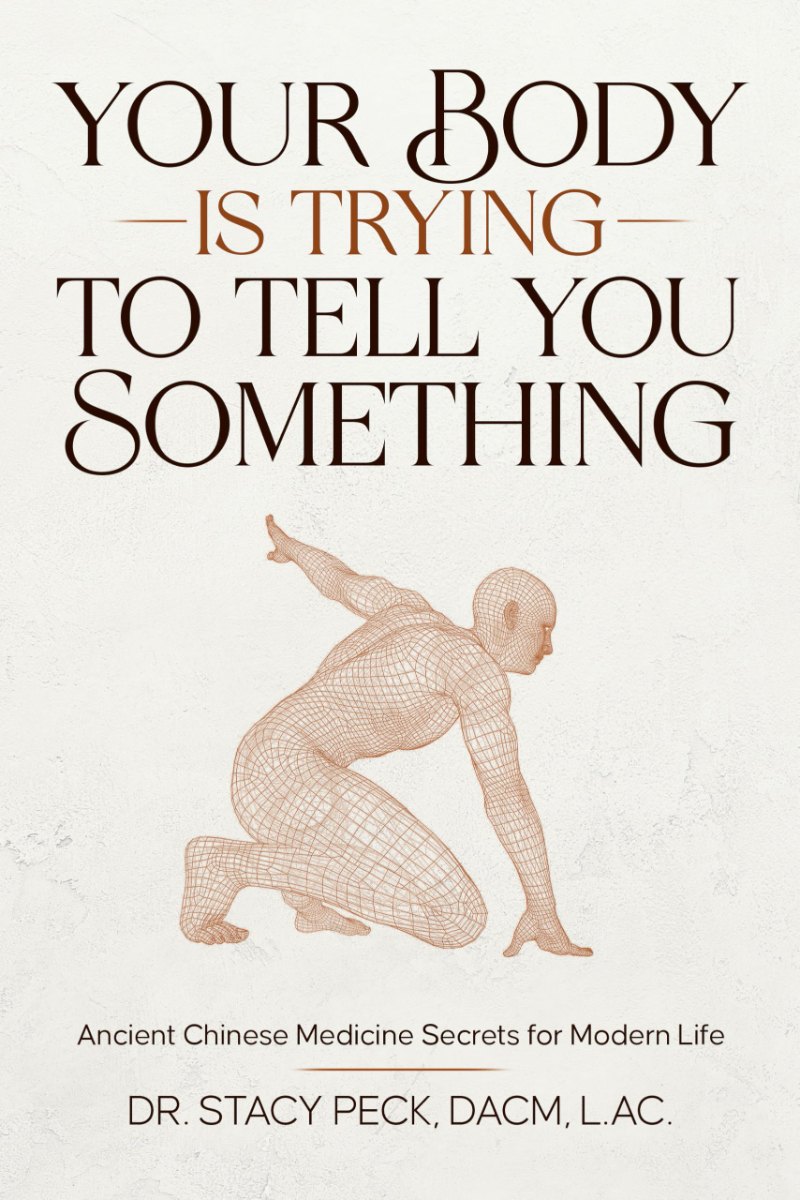
Your Body Is Trying to Tell You Something
83 everyday body signals decoded through the lens of Chinese medicine in Dr. Peck's consumer book. From morning headaches to afternoon energy crashes to the symptoms you've never had a name for — a complete field guide to the conversation your body is already having with you.
Get the Kindle Edition Get the PaperbackLooking for the practitioner's perspective on common wellness questions? What Would Your Acupuncturist Say? covers the questions patients ask most — also available in paperback.