There's a particular kind of tired that shows up in October. Summer's buzz is gone, but winter hasn't really arrived. The light goes strange. Your skin feels tight. You catch yourself sighing for no reason, and a scratchy throat seems to be going around — again.
In Chinese medicine, this in-between stretch isn't just weather. It's a changing of the guard between two entire energetic seasons, and your body feels the handoff. Once you understand what's happening, October stops feeling like a personal failure and starts looking like what it is: a transition you're built to move through — if you move with it instead of against it.
Autumn belongs to Metal: the season of letting go
Chinese medicine divides the year into five seasons, each paired with an element and a pair of organs. Autumn belongs to Metal, and Metal's organs are the Lung and Large Intestine.
Metal is the element of refinement — think of ore being purified, or leaves falling so the tree can survive winter. Its whole theme is letting go: releasing what's finished, clearing out what's stale, making space. That's why, in this system, autumn is associated with the emotion of grief and sadness. Not dramatic grief. Just a quiet heaviness, a tendency to feel wistful or flat as the days shorten. If October makes you a little melancholy for no obvious reason, Chinese medicine would say: that's not a malfunction. That's Metal.
Metal's color is white, its flavor is pungent (think ginger, garlic, scallion), and its climate is dryness. Which brings us to the thing your body is probably already complaining about.
Why fall dries you out (and what dryness does in TCM)
Of all the organs, the Lung dislikes dryness the most. In Chinese medicine the Lung is a delicate organ — it's the interface between your inside and the outside world, processing every breath you take. When autumn air turns dry, the Lung is the first to feel it.
That's why fall reliably brings the same cluster of complaints: dry skin, chapped lips, a dry cough that won't quit, a scratchy throat, dry nasal passages, even constipation (remember, the Large Intestine is Metal's partner organ — when fluids dry up, everything downstream slows down).
If you're thinking "this is just what happens in October," you're right — and Chinese medicine agrees. But it also says you don't have to just endure it. Dryness is countered with moisture, and the season gives you the tools: this is the moment for pears, soups, and congee. More on that below.
Is it normal to feel sadder in October?
Short answer: yes, and there's a framework for it. Every organ system in Chinese medicine processes an emotion, and the Lung processes grief. Autumn — the season of falling leaves, endings, shorter days — naturally stirs it.
This doesn't mean October sadness is a disorder. It means it's information. The Metal element asks a question every fall: what are you still carrying that it's time to release? An old resentment. A habit that's done. A version of yourself you've outgrown. I'll give you a small ritual for this at the end — because in this medicine, emotions aren't problems to fix. They're signals to listen to. (If you've read my book, you know this is the whole premise: your body is trying to tell you something.)
Then comes winter: Water, Kidneys, and the art of rest
As autumn deepens, the guard changes again — from Metal to Water, the element of winter. Water's organs are the Kidney and Bladder, and its theme is storage, rest, and conservation.
Where autumn was about release, winter is about going inward. The Kidneys are described in the classics as the root of your deep energy reserves — the savings account your body draws on all year. Winter is when you're supposed to stop spending and start saving: sleeping more, doing less, eating warming, nourishing food, protecting yourself from cold.
Water's emotion is fear — and its virtue is willpower. When Kidney energy runs low, people describe feeling oddly anxious, depleted, or like they're running on fumes. Sound like January? That's not a coincidence either.
Water's color is black (think black beans, black sesame — more below), and its flavor is salty. Nature is literally showing you the medicine if you know how to look.
Why you're so tired (it's not laziness)
Here's the part I most want you to hear: if your energy dips every October and November, that is not a character flaw. It's seasonal physiology.
In summer, your energy naturally expands outward — long days, social, active. In winter, it's supposed to contract inward — earlier nights, quieter rhythms, more rest. October and November are the hinge. Your body is trying to downshift, and modern life is shouting at it to keep performing at summer levels.
Fighting that downshift is, in Chinese medicine terms, spending from your Kidney reserves instead of replenishing them. The result: you limp into January already depleted, which is exactly when the deep-winter colds hit hardest. The tiredness is your body asking for the thing winter is designed to give it. Listen now, and January-you will be grateful.
What to eat during the fall-to-winter transition
You don't need a complicated protocol. You need to eat with the season instead of against it.
For the dryness of fall: moisten the Lungs. Pears are the classic — in Chinese medicine, pears are the fruit for dry coughs and scratchy throats (warm pear soup with a little honey is an old household remedy). White foods nourish Metal: cauliflower, daikon radish, white mushrooms, lotus root, lily bulb. Warm, cooked, soupy foods beat raw salads now — your digestion has to work harder as it gets cold, so give it a break.
For the descent into winter: build the reserves. Black foods nourish the Kidneys: black beans, black sesame seeds, black rice. Walnuts, slow-cooked stews, bone broth, congee for breakfast. A little salty flavor supports Water — miso soup counts. The rule of thumb: if it's warm, cooked, and slightly hearty, you're on the right track.
Ease off: iced drinks, raw smoothies, and big cold salads. Nothing wrong with them in July. In November, they're asking your digestion to do summer work in winter conditions.
Two acupressure points for the season change
You can do these tonight — no equipment, just your thumbs and a few quiet minutes.
LU7 (Lieque) — for wind, early colds, and stiff necks. This is the great wind-expelling point of the Lung channel. In Chinese medicine, colds begin when wind invades through the neck and nose — which is why that first-day-of-a-cold stiff neck and scratchy throat respond so well here. Find it on the thumb side of your forearm, about two finger-widths above the wrist crease, in the little dip between the tendons. Press firmly for 1–2 minutes on each side when you feel something coming on, or when autumn wind has gotten into your neck.
KID3 (Taixi) — for deep energy and winter reserves. This is the source point of the Kidney channel: the place its energy pools. Find it in the dip between your inner ankle bone and the Achilles tendon. Gentle, steady pressure here for 2–3 minutes is the classic way to tonify Kidney energy — think of it as making a small deposit in that savings account. Lovely before bed, especially as the nights get longer.
A simple letting-go ritual for autumn
Metal's question — what are you still carrying? — deserves an answer, not just a thought. Try this: one evening this week, write down three things you're done with. A grudge, a "should," a habit, a worry you've been rehearsing. Read them once. Then tear the paper up, or burn it safely, or just throw it away. It sounds small. In my experience, the body registers it.
Autumn is the season of release. Give it something to release.
Move with the season, not against it
The fall-to-winter transition asks three things of you: moisten what dryness dries out, rest before you're depleted, and let go of what's finished. That's it. Not a protocol, not a cleanse — just alignment with the season you're actually in.
Your body already knows how to do this. It's been trying to tell you. October's tiredness, the dry throat, the wistfulness — that's not your body failing. That's your body speaking Metal, then Water, right on schedule. Listen, and move with it.
Want more of this in your inbox? I share one short, practical Chinese medicine insight each week — foods, points, and body signals you can actually use. Get my free resources here and start with the free sample flashcards.
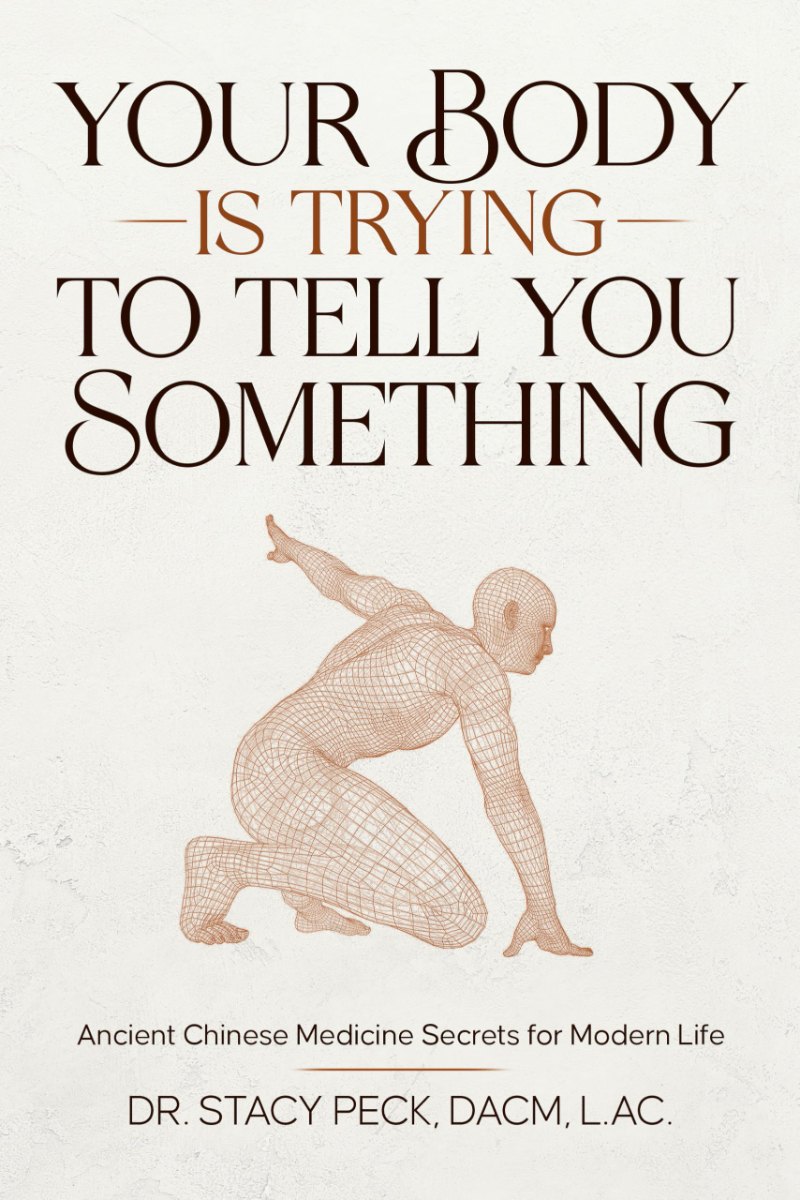
Your Body Is Trying to Tell You Something
83 everyday body signals decoded through the lens of Chinese medicine in Dr. Peck's consumer book. From morning headaches to afternoon energy crashes to the symptoms you've never had a name for — a complete field guide to the conversation your body is already having with you.
Get the Kindle Edition Get the PaperbackLooking for the practitioner's perspective on common wellness questions? What Would Your Acupuncturist Say? covers the questions patients ask most — also available in paperback.